I'm sorry, theatre.
I've been pretty strident about the need for a more radical approach to addressing racial disparity in American theatre, and I have pointed out a lot of what you were doing wrong.
I take it all back.
What I should have been saying is, "Just add rap music."
Apparently, we've been missing out. Maybe if we simply play rap music, Black people will spring up at the box office like cabbages.
Why haven't we thought of this?
See, that's the real problem. The problem isn't the racism embedded in the institutional structures we participate in. It's not playing enough rap music.
So all this transforming systems of power thing? Forget all of it.
Just blast some rap music.
Showing posts with label racism. Show all posts
Showing posts with label racism. Show all posts
March 7, 2014
October 6, 2012
Things I'm not debating or arguing about anymore
I’m not going to discuss these things anymore:
- Whether or not racism exists
- Whether or not people of color can be racist against White people
- Whether people of color being prejudiced against White people is on par with White people’s prejudice against people of color
- Whether or not sexism exists
- Whether women can be sexist against men
- Whether misandry is on par with misogyny
- Whether or not homophobia exists
- Whether or not LGBTQ people calling straight folks “breeders” is as bad as what straight people say and do to LGBTQ people
- Whether trans women are women, trans men are men, or the existence of other genders
- Whether or not transphobia exists
- Whether or not “die cis scum” is as bad as what cis people say and do to trans people
- Whether or not ableism exists
- Whether or not classism exist
- Anybody’s intent not to be racist, sexist, homophobic, transphobic, ableist, etc.
- Any information regurgitated from a dictionary or thesaurus
- Anything involving flies, honey, or vinegar when discussing the ways people express their experiences with systemic oppression
- Any variation of an opinion that states or implies that people on the receiving end of *-isms are crazy (disconnected from reality), stupid (incapable of analyzing their own experiences), or evil (motivated primarily by hate, anger, greed, etc.)
At this point, everything about these things that needs to be said has been said, and all arguments to the contrary are neither insightful, meaningful, correct, nor interesting.
So I’m not doing it anymore.
As for things I would talk about, here are a few:
- How fucked up dynamics play out in individual lives
- The ways that words, attitudes, beliefs, and actions act against play into fucked up dynamics despite our best intentions
- How fucked up dynamics play into what we determine to be beautiful, true, and good
- Ways we can challenge and subvert fucked up dynamics in our everyday lives
- Resources for detoxing our minds and spirits from the poison we ingest without knowing it
That sort of shit right there? I can talk about that all day long. That's what I want to talk about all day long. I can get somewhere with those conversations. I can feed my soul with real talk about this sort of stuff.
And you know what's funny? None of these discussions requires anybody to have done any specialized study on these things. Just an awareness that there are things about many lives that we don't see because we don't have to and a willingness to learn more about what we don't understand. In cases where I have a privilege that others don't, I've been amazed at how patient and gracious people are with me when I simply listen and accept their truth as their truth instead of dismissing or denying it just because it doesn't mesh with what I think should be true about their lives.
Really, it's that fucking simple.
June 18, 2012
Linked without comment
Rowe Entertainment, Inc. vs. The William Morris Agency, Inc.
The sad news is that I discovered something similar with someone else I was working on a play with.
The sad news is that I discovered something similar with someone else I was working on a play with.
January 6, 2012
2012: The year of Black people as subjects
Kicking off 2012 on the racism front, we have this video, "Shit White Girls Say . . . to Black Girls"
And then we have this post at A Poor Player, which prompted 99Seats to write "Shit White Theatremakers Say" (and then "More Shit White Theatremakers Say" in response to Scott's comment on the original post and in 99Seats' follow-up).
I'm not going to weigh in on that particular discussion because, frankly, I'm tired of it. I can't even work up the energy to get pissed off. But, I can say that it has been my experience that when I told Black people outside of theatre that I'm a playwright, several Black people piped up and told me that they used to enjoy participating in theatre but got out of it because it's so racist.
What I am going to mention, which the video and the blog posts at A Poor Player and by 99Seats exemplify, is a trend I noticed in 2011 that I'm hoping will be over for 2012. For lack of a better term, I'm going to call it Black People* As Objects. To be more precise, I'm talking about Black people as objects of ridicule, scorn, fear, study, charity, validation, and so on. From that ridiculous article in Psychology Today about Black women being "objectively" less attractive than women of other races to pretty much anything that comes from the mouth of a GOP candidate about Black folks, it seems that a lot of people who are not Black have a lot to say about what the lives and actions of Black people are supposed to mean. Essentially attempting to probe and prod us like lab animals. Which could almost not be racist if said individuals, I dunno, bothered to actually have a conversation with Black people (as in Black persons, not Black People (TM)) where they sought to truly understand and relate to us as persons and not as objects or symbols.
I don't put a lot of stock into new year's resolutions, but if I were to make one for myself, I'd say that 2012 is the Year of Black People as Subjects -- subjects who live their own lives, have their own reasons for doing things, experience their own trials and triumphs, construct their own meanings, have their own thoughts and feelings as beliefs, and so on. The challenge for 2012 will be focusing my energy on those who are capable of talking to and talking with Black people and not talking at, talking for, or talking about us. From now on, I'm only going to get involved with discussions that involve Black people only when I can see that the discussion is framed around Black people as subjects. If that is not the case, I'm generally going to ignore it or poke fun at it. Maybe even link to this post, if I'm feeling generous.
The rule of thumb is this: if the discussion is about Black people or people of color, and not by Black people or people of color, it should ask Black people or people of color for their input. Not to debate or otherwise argue about basic shit (like whether racism is real in theatre or anywhere else), but to more fully understand something from the perspective of those who have to live with it.
I know that some people would ask, "Well, what about discussions about White people?" To be honest, that's not really my concern. Yes, that's a double standard. But it's a double standard I've experienced as necessary in order to have a real dialogue and not revert to White people telling Black people and other people of color what to do, what to say, how to say it, and how to think and feel about it. Which, again, goes back to treating Black people like objects.
And all that stuff I said above? That goes for discussions about women too.
* Particularly Black women for some reason. I don't know why so many people in 2011 were so interested in who we're dating (or not dating), fucking (or not fucking), marrying (or not marrying), or giving birth (or not giving birth) to.
And then we have this post at A Poor Player, which prompted 99Seats to write "Shit White Theatremakers Say" (and then "More Shit White Theatremakers Say" in response to Scott's comment on the original post and in 99Seats' follow-up).
I'm not going to weigh in on that particular discussion because, frankly, I'm tired of it. I can't even work up the energy to get pissed off. But, I can say that it has been my experience that when I told Black people outside of theatre that I'm a playwright, several Black people piped up and told me that they used to enjoy participating in theatre but got out of it because it's so racist.
What I am going to mention, which the video and the blog posts at A Poor Player and by 99Seats exemplify, is a trend I noticed in 2011 that I'm hoping will be over for 2012. For lack of a better term, I'm going to call it Black People* As Objects. To be more precise, I'm talking about Black people as objects of ridicule, scorn, fear, study, charity, validation, and so on. From that ridiculous article in Psychology Today about Black women being "objectively" less attractive than women of other races to pretty much anything that comes from the mouth of a GOP candidate about Black folks, it seems that a lot of people who are not Black have a lot to say about what the lives and actions of Black people are supposed to mean. Essentially attempting to probe and prod us like lab animals. Which could almost not be racist if said individuals, I dunno, bothered to actually have a conversation with Black people (as in Black persons, not Black People (TM)) where they sought to truly understand and relate to us as persons and not as objects or symbols.
I don't put a lot of stock into new year's resolutions, but if I were to make one for myself, I'd say that 2012 is the Year of Black People as Subjects -- subjects who live their own lives, have their own reasons for doing things, experience their own trials and triumphs, construct their own meanings, have their own thoughts and feelings as beliefs, and so on. The challenge for 2012 will be focusing my energy on those who are capable of talking to and talking with Black people and not talking at, talking for, or talking about us. From now on, I'm only going to get involved with discussions that involve Black people only when I can see that the discussion is framed around Black people as subjects. If that is not the case, I'm generally going to ignore it or poke fun at it. Maybe even link to this post, if I'm feeling generous.
The rule of thumb is this: if the discussion is about Black people or people of color, and not by Black people or people of color, it should ask Black people or people of color for their input. Not to debate or otherwise argue about basic shit (like whether racism is real in theatre or anywhere else), but to more fully understand something from the perspective of those who have to live with it.
I know that some people would ask, "Well, what about discussions about White people?" To be honest, that's not really my concern. Yes, that's a double standard. But it's a double standard I've experienced as necessary in order to have a real dialogue and not revert to White people telling Black people and other people of color what to do, what to say, how to say it, and how to think and feel about it. Which, again, goes back to treating Black people like objects.
And all that stuff I said above? That goes for discussions about women too.
* Particularly Black women for some reason. I don't know why so many people in 2011 were so interested in who we're dating (or not dating), fucking (or not fucking), marrying (or not marrying), or giving birth (or not giving birth) to.
May 1, 2011
on privilege in social justice circles
We have heard entirely too much from men about women and gender, from whites about people of color, from heterosexuals about lesbians and gays and sexual preference, and from economically over-privileged people about workers and the poor. Claiming to be able to adopt the critical persona of the Other in the name of her emancipation is unlikely to earn one the applause of the Other.Sandra Harding, "Reinventing Ourselves as Other" (American Feminist Thought at Century's End: A Reader)
February 26, 2011
fezzik on hostility and privilege
Fezzik? You mean Andre the Giant from The Princess Bride?
I recently replaced my copy of The Princess Bride DVD, and for some reason when I watched it, I really identified with Fezzik. I even looked up some tropes to figure out what made Fezzik so compelling. It wasn't until I reflected on a few recent interactions that I made the connections.
At one point in time (until fairly recently, if you follow this blog fairly regularly), one of the things that consistently irritated and saddened me when it came to That Conversation was when people would accuse me of a hostility that I didn't feel. Vehement, yes. Passionate, yes. Intense, definitely. But never hostile. There was nothing malevolent about anything I said, yet I kept being treated as though I was pretty much telling people to go die in a fire, even though I feel I exercise great restraint compared to what I've witnessed in other people. It's pretty confusing and frustrating to deal with, especially when you see other people say far worse without getting called on it.
For the longest time, I thought it was simply derailing or projecting the Angry Black Woman stereotype onto me because I spoke my mind without going my way to express myself in a conciliatory or equivocating way so as not to offend people more privileged than me (ie, not all White people, not all men, I don't mean you, etc.).
But now I believe there is more going on than that.
Back to Fezzik
Here you have this character, a giant, with immense physical power, who has to be careful with how he navigates the world around him lest he cause harm to others. I am like this when it comes to words. Whether I intend it or not, the words I use carry tremendous power. You would think that'd be obvious, but it really isn't. Unlike Fezzik, a good chunk of the time, I literally don't know my own strength. I never thought of myself or the way I expressed myself as particularly powerful. Truth be told, I'm very introverted (almost withdrawn) and rather shy (especially around people I don't know well). Nevertheless, a love tap from Natalie Portman wouldn't feel the same as a love tap from George Foreman. So I've resolved to be a bit more careful in my approach, or at the very least give fair warning.
I honestly don't know what to feel about this. On the one hand, it's always good to affirm something empowering about yourself. As someone who faces marginalization due to race, gender, sexuality, and class, it's hard not to internalize the barrage of messages telling me how powerless I am (and how good it is that I remain so). It's difficult to describe what kind of effort that takes, but it's very similar to what survivors of abuse go through.
On the other hand, it sucks that something that should be positive - in this case, a power with words - becomes a liability because of those same forces that seek to undermine my sense of my own power, even as embodied in the same people who endeavor to oppose those forces.
Power versus privilege
It's quite a paradox. But that's how it goes for pretty much any empowering trait coming from marginalized people. Any attempt to claim your own power without paying your dues (so to speak) is always met with resistance. Speaking intelligently, and with passion and clarity, without apology, is not praiseworthy in anyone except well-off straightwhitedudes.
Don't believe me? Go to any social justice blog or website (like this one) where a marginalized person states an opinion without coddling the privileged. You won't have to dig very deep to find somebody acting like that person just said, "FUCK OFF AND DIE MOTHERFUCKER!!!" Even if the "meanie" is responding to something fucked up that someone else said. Even if that person does not use all caps or any exclamation points. Even if that person does not make a direct accusation against anyone.
If you're feeling up to it, try prodding a bit. Say something like, "Really? Where did s/he say that?" If you don't get a bunch of projections and assumptions and conjecture, you'll get them saying something about the tone*. Note who it comes from. I'm willing to bet money that a good chunk of the time, when someone objects to "tone"**, it's coming from a place of privilege.
* That's not to say anybody from a marginalized identity has a carte blache to be an asshole. But they don't have to be polite to you when you reinforce ugly shit. When it comes to the deliberately obtuse or willfully ignorant, my personal preference is to say something sarcastic then disengage.
** If the bulk of your objection can be, "Watch your tone," please don't say it. It's what you say to disobedient children, not adults who you presume to treat with respect. Even if you think they're being immature, don't say it. If the issue you're talking about is important to you, and the person you're talking to is someone whom you otherwise respect, it's not worth destroying that to take a few pot shots at them.
So what now?
Speaking for myself, it would help a great deal to ask rather than assume. It's pretty hard to read intent on the internet at the best of times, so it would probably not be remiss to clarify before proceeding. Even - scratch that - especially if you think you know what's going on. There are tons of conversations that could have saved a lot of turmoil had myself or other participants simply asked about where everyone was coming from before rushing to attack or defense. And when it comes to discussing power and privilege and oppression and the myriad forms they take, it comes at a great cost to the people on the shit end of that stick.
I recently replaced my copy of The Princess Bride DVD, and for some reason when I watched it, I really identified with Fezzik. I even looked up some tropes to figure out what made Fezzik so compelling. It wasn't until I reflected on a few recent interactions that I made the connections.
At one point in time (until fairly recently, if you follow this blog fairly regularly), one of the things that consistently irritated and saddened me when it came to That Conversation was when people would accuse me of a hostility that I didn't feel. Vehement, yes. Passionate, yes. Intense, definitely. But never hostile. There was nothing malevolent about anything I said, yet I kept being treated as though I was pretty much telling people to go die in a fire, even though I feel I exercise great restraint compared to what I've witnessed in other people. It's pretty confusing and frustrating to deal with, especially when you see other people say far worse without getting called on it.
For the longest time, I thought it was simply derailing or projecting the Angry Black Woman stereotype onto me because I spoke my mind without going my way to express myself in a conciliatory or equivocating way so as not to offend people more privileged than me (ie, not all White people, not all men, I don't mean you, etc.).
But now I believe there is more going on than that.
Back to Fezzik
Here you have this character, a giant, with immense physical power, who has to be careful with how he navigates the world around him lest he cause harm to others. I am like this when it comes to words. Whether I intend it or not, the words I use carry tremendous power. You would think that'd be obvious, but it really isn't. Unlike Fezzik, a good chunk of the time, I literally don't know my own strength. I never thought of myself or the way I expressed myself as particularly powerful. Truth be told, I'm very introverted (almost withdrawn) and rather shy (especially around people I don't know well). Nevertheless, a love tap from Natalie Portman wouldn't feel the same as a love tap from George Foreman. So I've resolved to be a bit more careful in my approach, or at the very least give fair warning.
I honestly don't know what to feel about this. On the one hand, it's always good to affirm something empowering about yourself. As someone who faces marginalization due to race, gender, sexuality, and class, it's hard not to internalize the barrage of messages telling me how powerless I am (and how good it is that I remain so). It's difficult to describe what kind of effort that takes, but it's very similar to what survivors of abuse go through.
On the other hand, it sucks that something that should be positive - in this case, a power with words - becomes a liability because of those same forces that seek to undermine my sense of my own power, even as embodied in the same people who endeavor to oppose those forces.
Power versus privilege
It's quite a paradox. But that's how it goes for pretty much any empowering trait coming from marginalized people. Any attempt to claim your own power without paying your dues (so to speak) is always met with resistance. Speaking intelligently, and with passion and clarity, without apology, is not praiseworthy in anyone except well-off straightwhitedudes.
Don't believe me? Go to any social justice blog or website (like this one) where a marginalized person states an opinion without coddling the privileged. You won't have to dig very deep to find somebody acting like that person just said, "FUCK OFF AND DIE MOTHERFUCKER!!!" Even if the "meanie" is responding to something fucked up that someone else said. Even if that person does not use all caps or any exclamation points. Even if that person does not make a direct accusation against anyone.
If you're feeling up to it, try prodding a bit. Say something like, "Really? Where did s/he say that?" If you don't get a bunch of projections and assumptions and conjecture, you'll get them saying something about the tone*. Note who it comes from. I'm willing to bet money that a good chunk of the time, when someone objects to "tone"**, it's coming from a place of privilege.
* That's not to say anybody from a marginalized identity has a carte blache to be an asshole. But they don't have to be polite to you when you reinforce ugly shit. When it comes to the deliberately obtuse or willfully ignorant, my personal preference is to say something sarcastic then disengage.
** If the bulk of your objection can be, "Watch your tone," please don't say it. It's what you say to disobedient children, not adults who you presume to treat with respect. Even if you think they're being immature, don't say it. If the issue you're talking about is important to you, and the person you're talking to is someone whom you otherwise respect, it's not worth destroying that to take a few pot shots at them.
So what now?
Speaking for myself, it would help a great deal to ask rather than assume. It's pretty hard to read intent on the internet at the best of times, so it would probably not be remiss to clarify before proceeding. Even - scratch that - especially if you think you know what's going on. There are tons of conversations that could have saved a lot of turmoil had myself or other participants simply asked about where everyone was coming from before rushing to attack or defense. And when it comes to discussing power and privilege and oppression and the myriad forms they take, it comes at a great cost to the people on the shit end of that stick.
February 7, 2011
Continuing that Conversation (or: White people, we need to talk)
The most important thing to remember
Transgressive discourse is difficult, even for people who know what those words mean without looking them up. I'm not asking anyone who comments on this post to agree, but at the very least acknowledge and respect the difficulty of the task and not undermine my purpose for doing it. This is not merely a stimulating discussion for me. This is a purpose that has grown from experiences that have shaped every aspect my my entire life. Part of that is speaking candidly about things that I've been trained to be silent about. I am bringing a great deal of myself to bear in this - even the ugly and messy parts - not merely the stuff that makes for a lively conversation. Every time I endeavor to have That Conversation, I am going against my programming. Every time I speak on this issue, I do so despite what I've been taught rather than because of it. Every time I talk to you (I mean you reading this right now), I'm speaking through the pain and fear and sadness and exhaustion to reach you. I still have hope.
Do not make this hope be misplaced.
Owning my shit
I'm a queer Black woman who grew up in the South, so everything I say is coming from that experience. That's not to say other experiences are less important, but I've found that trying to speak for everyone means that I wind up not saying much at all. As a queer Black woman who grew up in the back yard of the capital of the Confederacy, here are a few life lessons I picked up along the way. I'm not saying they're good, or even right, but it's what I bring to That Conversation.
Where I'm coming from
About 2 weeks ago, I did a post on having That Conversation, where I laid down some guidelines on how to make That Conversation one that's worth having. I included a lot of stuff applicable to anyone who is participating in That Conversation. But now I want to focus on White folks for a minute because, in my experience, when That Conversation turns to shit, it's because of something a White person said.
I'm not talking about one of Those Other White People, either. I'm talking about White people who live in blue states, have dartboards with Glenn Beck's picture on them, march and protest against issues that harm people of color, and even maintain anti-racist blogs. But that doesn't stop you from fucking up.
Telling you that you're fucking up is not about hating you. It's not about making you feel guilty or ashamed of being White. Guilt-ridden and shame-filled White people are fearful White people. Fearful White people are angry White people. Angry White people have never been good news for Black people. Also, it doesn't make any sense. White guilt does not improve my situation in the least. As a matter of fact, it's more likely to make it worse because resentment doesn't live too far away from guilt.
As I said before, I'm not in this as a way of improving human relations. I am not from the Can't We All Just Get Along School of Racial Justice. I'm in this to transform society. This is my way of doing that: by changing the ways we relate to one another everyday without even thinking about it (see above). It has nothing to do with Good Guys and Bad Guys duking it out for the Fate of the World. It's about making our homes, families, neighborhoods, cities, and world a better place for everyone, including those who are not straight, White, and/or male. It's about becoming the change we want to see.
Oftentimes, having That Conversation with White people is like having an alcoholic in your family. You can't keep mopping up the puke, washing out the piss, making excuses for why they miss work, or explaining away destructive or abusive behavior because they were so drunk. You love them, and they're wonderful when they're sober, but things can't go on like this. Sometimes, the most loving thing you can do for them is to stop enabling them. Sometimes, the loving thing to do is hold them accountable for what they do. Sometimes, you show someone you love them by telling them what they don't want to hear. That's the point where I'm at now when it comes to That Conversation.
Think the alcoholism metaphor is a stretch? It isn't.
What almost never happens
Let me tell you about an encounter I had in a grocery store. I was picking up a few ingredients for the dish I was bringing to the next Community Dish meeting. Grocery Store Dude and his girlfriend(?) Grocery Store Chick were standing in the aisle chatting right next to the canned tomatoes, which I needed to look at to find what I was looking for. The guy tells me to go around them. I say, "Actually, I needed to get these," reaching for the petite diced tomatoes, and make my way. I am genuinely upset by this because I do not go out of my way to be rude to people. In fact, I'm usually excessively polite even when someone doesn't deserve it (like a neighbor playing loud ass techno at 2AM on a weeknight). My roommate -- one of the geekiest-looking, Starbucks-drinking, Macbook-carrying, NPR-listening, most good-natured Wonderbread motherfuckers you'll ever meet -- has cursed out more people than I have. I tend to internalize a lot of my aggravations and irritations. So Grocery Store Dude is now Entitled Asshole. I'm trying to shop, and this shit has been bothering me. Now I get in the line, and I see GSD/EA.
If only it happened like this with That Conversation.
Whenever I have That Conversation with a White person, and I talk about a particular kind of behavior that I see a lot in White people and what that says to me as a queer Black woman, it almost never leads to a White person saying, "Damn, I do that. I thought I was [doing something else] but looking at it that way, yeah, that's kinda messed up. Hey, if I ever did that to you, my bad. I'm sorry. That's not what I meant. I'll be a lot more careful about this from now on."
What often happens is some variation of, "Fuck you! I'm not racist! I majored in African American studies! I fucked a Black person once! I voted for Obama! I watch Tyler Perry movies! I adopted an African baby! How DARE you call me racist!"
Wanna know how many times I actually called someone racist when having That Conversation? Zero. Even in the rare instances when I directly said, "Soandso is racist," I was talking about Mel Gibson, Dr. Laura, and that guy 99Seats cursed out last year.
What you usually do -- and what it does to me
When you do things like this, you look a lot like Oedipus. Trying to avoid a prophecy, he does everything that makes him wind up killing his dad, fucking his mom, and gouging his eyes out. Despite all his efforts not to be called a patricidal motherfucker, that's exactly what he became.
We're storytellers here in theatre blogosphere, so let's tell a story.
You are an actor. You've got your MFA from Yale. You did Juilliard. You were personally instructed by The Great So And So. Finally, those years of preparation paid off! You've been cast in the lead role for a new play by Hot New Playwright. Throughout rehearsals, you're thinking and reading about this character. You are really living this role. You even keep a diary from the character's point of view. On opening night, you give your performance. There is applause. The next day, you read a review in The Village Voice, and the critic has slammed your performance. He calls it cliche, self-indulgent, and lifeless. All that work, and this what he has to say! Who the fuck does he think he is? Does he have an MFA in Acting from Yale? Did he go to Juilliard? Did this asshole study with The Great So And So? Did they keep a daily diary from the character's point of view? Did he see how the audience responded to you? No! So fuck him and his bullshit plebe aesthetics (hi, Josh). But those voices are still in your head. Am I really any good, or am I just fooling myself? Did I truly give a compelling performance? Was my audience engaged with how I portrayed this character? Were they just clapping to be polite? What if The Village Voice is right? What if I failed? Will I be able to land a leading role ever again? Am I really any good?
If this fictional performance were the same as That Conversation, the actor would have rallied the other actors in the show, gone to the critic's birthday party, cornered his at the bar, shoved his resume in the critic's face, and demanded a public apology for the unflattering review (complete with groveling, preferably on broken glass).
Really, White people, what do you expect to happen when a person of color tells you that something you did smelled a little fishy?
I am incapable of responding rationally to that shit. When you do shit like that, this is one of the things you're triggering for me. The response would be similar to what you would get if you told a sexual assault survivor that you know about rape and sexual abuse because you used to work at RAINN. If that's not what you're going for, don't do this to me. If you have done this to me, you probably owe me an apology because you hurt me more than you think you did and definitely more than I trust you enough to tell you.
(And before somebody jumps down my throat about not comparing the trauma of racism to the trauma of sexual abuse, do not fucking go there. I speak from experience, and that's all the fuck you need to know.)
Just tell us what to say! Tell us what to do!
As HAL 9000 would say, "I can't do that, Dave."
Which of the following is more likely?
I have a vested interest in getting White people to stop doing some of the shit I talked about before. I have a powerful, personal stake in White people getting a fucking clue. If there is a magic combination of words and body language that would get you to that point where I can talk about racism with you and not worry about when you're going to fuck it up, I would use it. Trust me on this.
On "false accusations" of racism
You would think that, for a White person, the main question they have about participating in That Conversation would be: How do I not fuck this up?
But it's not.
The question they usually want answered is: What do I do if a person of color -- fuck it, let's be honest -- what do I do if one of those evil loudmouthed Black bitches says that I did something racist?
I honestly don't get this. I mean, if I were cleaning your house or cooking soul food, you'd listen to me about without a problem. But when it's That Conversation, suddenly everything I say is suspect? When it's That Conversation, White people seem ready and eager to write us off as crazy, stupid, lazy, and/or evil. It won't be those words, of course. But that's what the arguments would boil down to.
It sucks to be accused of doing shit you didn't do. Nobody's denying that. Innocent Black people have been accused of wrongdoing too, with consequences way more serious than our feelings getting hurt (Ask my uncle why he doesn't have front teeth). I had a classmate in middle school (a White girl) threaten to kick my ass because someone else played a prank on her and said I stole something from her purse. So I know what it's like to be accused of doing stuff I didn't do and made to feel unsafe because of it.
Yet, sometimes I do the wrong thing. Sometimes I'm careless. Sometimes I hurt people. I don't mean to. I'm not a sadist. It still happens, though. At that point, my responsibility is to acknowledge the impact of my actions, not to defend my honor or prove my innocence.
The vast majority of the time, that's what a "false accusation" of racism is -- someone reminding you that what you just said or did brought something hurtful, even harmful, to their interaction with you. At that point, it's not about That Conversation being productive for you but for you not causing pain to another human being.
And that's what it's all about, really -- being better at being whole human beings. It's hard to do that when we keep playing the same roles and the same rules.
Transgressive discourse is difficult, even for people who know what those words mean without looking them up. I'm not asking anyone who comments on this post to agree, but at the very least acknowledge and respect the difficulty of the task and not undermine my purpose for doing it. This is not merely a stimulating discussion for me. This is a purpose that has grown from experiences that have shaped every aspect my my entire life. Part of that is speaking candidly about things that I've been trained to be silent about. I am bringing a great deal of myself to bear in this - even the ugly and messy parts - not merely the stuff that makes for a lively conversation. Every time I endeavor to have That Conversation, I am going against my programming. Every time I speak on this issue, I do so despite what I've been taught rather than because of it. Every time I talk to you (I mean you reading this right now), I'm speaking through the pain and fear and sadness and exhaustion to reach you. I still have hope.
Do not make this hope be misplaced.
Owning my shit
I have almost reached the regrettable conclusion that the Negro's great stumbling block in his stride toward freedom is not the White Citizen's Counciler or the Ku Klux Klanner, but the white moderate [...] Shallow understanding from people of good will is more frustrating than absolute misunderstanding from people of ill will. Lukewarm acceptance is much more bewildering than outright rejection.
-- MLK, Letter from a Birmingham Jail
I'm a queer Black woman who grew up in the South, so everything I say is coming from that experience. That's not to say other experiences are less important, but I've found that trying to speak for everyone means that I wind up not saying much at all. As a queer Black woman who grew up in the back yard of the capital of the Confederacy, here are a few life lessons I picked up along the way. I'm not saying they're good, or even right, but it's what I bring to That Conversation.
- It's far easier to deal with an honest bigot than with Well Meaning White Liberals.
- Most White women cannot be trusted with anything important - not my beliefs, not my values, not my feelings, not my humanity.
- Black men often love but do not respect Black women.
- Black women are often better at hating Black women than either White people or men.
- White people do not know how to treat Black women with both respect and compassion; it has to be one or the other - pity or fear.
- To most everyone except other Black women, to be Black and a woman (not merely female) is an oxymoron.
- In every interaction with White people, I am on guard for racial microaggressions they don't even know they perpetuate.
- My deepest and most enduring scars come from ignorance and indifference, not hatred.
- A lot of people really do believe that a Black woman's life is a public service.
- White people (particularly White men) need to be right, even if it makes them do wrong.
- By and large, I am afraid of White people (especially White women).
Where I'm coming from
We renounce no friendship. But it may be the part of a friend to rebuke a friend's folly.
--JRR Tolkien, The Silmarillion
About 2 weeks ago, I did a post on having That Conversation, where I laid down some guidelines on how to make That Conversation one that's worth having. I included a lot of stuff applicable to anyone who is participating in That Conversation. But now I want to focus on White folks for a minute because, in my experience, when That Conversation turns to shit, it's because of something a White person said.
I'm not talking about one of Those Other White People, either. I'm talking about White people who live in blue states, have dartboards with Glenn Beck's picture on them, march and protest against issues that harm people of color, and even maintain anti-racist blogs. But that doesn't stop you from fucking up.
Telling you that you're fucking up is not about hating you. It's not about making you feel guilty or ashamed of being White. Guilt-ridden and shame-filled White people are fearful White people. Fearful White people are angry White people. Angry White people have never been good news for Black people. Also, it doesn't make any sense. White guilt does not improve my situation in the least. As a matter of fact, it's more likely to make it worse because resentment doesn't live too far away from guilt.
As I said before, I'm not in this as a way of improving human relations. I am not from the Can't We All Just Get Along School of Racial Justice. I'm in this to transform society. This is my way of doing that: by changing the ways we relate to one another everyday without even thinking about it (see above). It has nothing to do with Good Guys and Bad Guys duking it out for the Fate of the World. It's about making our homes, families, neighborhoods, cities, and world a better place for everyone, including those who are not straight, White, and/or male. It's about becoming the change we want to see.
Oftentimes, having That Conversation with White people is like having an alcoholic in your family. You can't keep mopping up the puke, washing out the piss, making excuses for why they miss work, or explaining away destructive or abusive behavior because they were so drunk. You love them, and they're wonderful when they're sober, but things can't go on like this. Sometimes, the most loving thing you can do for them is to stop enabling them. Sometimes, the loving thing to do is hold them accountable for what they do. Sometimes, you show someone you love them by telling them what they don't want to hear. That's the point where I'm at now when it comes to That Conversation.
Think the alcoholism metaphor is a stretch? It isn't.
What almost never happens
Let me tell you about an encounter I had in a grocery store. I was picking up a few ingredients for the dish I was bringing to the next Community Dish meeting. Grocery Store Dude and his girlfriend(?) Grocery Store Chick were standing in the aisle chatting right next to the canned tomatoes, which I needed to look at to find what I was looking for. The guy tells me to go around them. I say, "Actually, I needed to get these," reaching for the petite diced tomatoes, and make my way. I am genuinely upset by this because I do not go out of my way to be rude to people. In fact, I'm usually excessively polite even when someone doesn't deserve it (like a neighbor playing loud ass techno at 2AM on a weeknight). My roommate -- one of the geekiest-looking, Starbucks-drinking, Macbook-carrying, NPR-listening, most good-natured Wonderbread motherfuckers you'll ever meet -- has cursed out more people than I have. I tend to internalize a lot of my aggravations and irritations. So Grocery Store Dude is now Entitled Asshole. I'm trying to shop, and this shit has been bothering me. Now I get in the line, and I see GSD/EA.
ME: Excuse me? Sir?Now he's Grocery Store Dude again. I leave feeling a lot better because I stood up for myself and had my experience acknowledged and validated.
HIM: Sir? Who? Me?
ME: Yeah. Do you have any idea how rude you were to me back there.
HIM: Rude to you? What did I do?
ME: I was trying to get a can of diced tomatoes. You were talking to your lady, who just happened to be in the way, and you gave me some smartassed one-liner.
HIM: Oh. I didn't mean anything by it. I apologize.
ME: Thank you.
If only it happened like this with That Conversation.
Whenever I have That Conversation with a White person, and I talk about a particular kind of behavior that I see a lot in White people and what that says to me as a queer Black woman, it almost never leads to a White person saying, "Damn, I do that. I thought I was [doing something else] but looking at it that way, yeah, that's kinda messed up. Hey, if I ever did that to you, my bad. I'm sorry. That's not what I meant. I'll be a lot more careful about this from now on."
What often happens is some variation of, "Fuck you! I'm not racist! I majored in African American studies! I fucked a Black person once! I voted for Obama! I watch Tyler Perry movies! I adopted an African baby! How DARE you call me racist!"
Wanna know how many times I actually called someone racist when having That Conversation? Zero. Even in the rare instances when I directly said, "Soandso is racist," I was talking about Mel Gibson, Dr. Laura, and that guy 99Seats cursed out last year.
What you usually do -- and what it does to me
When you grow in a racist, patriarchal, homophobic, classist, sexist culture your way of thinking becomes infused with ideas that are necessarily counter to freedom and basic human respect. Even the most conscious amongst us will continually revert to patterns of behaviour, thought, or speech, that are counter to our stated beliefs. Due to a constant desire to privilege our experience and our existence over another often we do not even recognize these lapses.
--Womanist Musings, "Get Your 101 On"
When you do things like this, you look a lot like Oedipus. Trying to avoid a prophecy, he does everything that makes him wind up killing his dad, fucking his mom, and gouging his eyes out. Despite all his efforts not to be called a patricidal motherfucker, that's exactly what he became.
We're storytellers here in theatre blogosphere, so let's tell a story.
You are an actor. You've got your MFA from Yale. You did Juilliard. You were personally instructed by The Great So And So. Finally, those years of preparation paid off! You've been cast in the lead role for a new play by Hot New Playwright. Throughout rehearsals, you're thinking and reading about this character. You are really living this role. You even keep a diary from the character's point of view. On opening night, you give your performance. There is applause. The next day, you read a review in The Village Voice, and the critic has slammed your performance. He calls it cliche, self-indulgent, and lifeless. All that work, and this what he has to say! Who the fuck does he think he is? Does he have an MFA in Acting from Yale? Did he go to Juilliard? Did this asshole study with The Great So And So? Did they keep a daily diary from the character's point of view? Did he see how the audience responded to you? No! So fuck him and his bullshit plebe aesthetics (hi, Josh). But those voices are still in your head. Am I really any good, or am I just fooling myself? Did I truly give a compelling performance? Was my audience engaged with how I portrayed this character? Were they just clapping to be polite? What if The Village Voice is right? What if I failed? Will I be able to land a leading role ever again? Am I really any good?
If this fictional performance were the same as That Conversation, the actor would have rallied the other actors in the show, gone to the critic's birthday party, cornered his at the bar, shoved his resume in the critic's face, and demanded a public apology for the unflattering review (complete with groveling, preferably on broken glass).
Really, White people, what do you expect to happen when a person of color tells you that something you did smelled a little fishy?
THEM: That shit you just did sorta raised my racism red flags.Want me to shut the fuck up right quick? Act like you have nothing to learn about racism. Want me to stop talking to you? Keep doing it. Don't be fooled. It's not because you convinced me with the power of your argument. It's because you've proven that you cannot be trusted with That Conversation. Frankly, it leaves me with the pain of being silenced and doesn't mean a fucking thing to whoever does this. It's very difficult to describe what it feels like to be on the receiving end of this. How about I share an experience of mine? One of the few cases in my life where I burst into tears in front of a crowd of people and started crying uncontrollably was when White person (a sociology major!) told me (about racism, mind you), "We already know this stuff."
YOU: What the hell are you talking about? I [insert Not A Racist Credentials].
THEM: Oh. Well, now that you put it that way, forget everything I said. It was completely baseless. Carry on.
I am incapable of responding rationally to that shit. When you do shit like that, this is one of the things you're triggering for me. The response would be similar to what you would get if you told a sexual assault survivor that you know about rape and sexual abuse because you used to work at RAINN. If that's not what you're going for, don't do this to me. If you have done this to me, you probably owe me an apology because you hurt me more than you think you did and definitely more than I trust you enough to tell you.
(And before somebody jumps down my throat about not comparing the trauma of racism to the trauma of sexual abuse, do not fucking go there. I speak from experience, and that's all the fuck you need to know.)
Just tell us what to say! Tell us what to do!
The problem of course with White men is we've just got to have an answer. We never just say, "Hmm, I dunno, let's look that up. [...] We're the authority. "I'll tell you even though what I'm telling you is total crap."
--Tim Wise (at 1:21:10)
As HAL 9000 would say, "I can't do that, Dave."
Which of the following is more likely?
A. I'm deliberately keeping this information secret.In case you were wondering, the answer is D.
B. I don't know what I'm talking about when it comes to race.
C. I lack the drive to find out how.
D. There are no simple rules or simple answers.
I have a vested interest in getting White people to stop doing some of the shit I talked about before. I have a powerful, personal stake in White people getting a fucking clue. If there is a magic combination of words and body language that would get you to that point where I can talk about racism with you and not worry about when you're going to fuck it up, I would use it. Trust me on this.
On "false accusations" of racism
Sometimes, even after you’ve given it serious thought, you’ll come to the conclusion that a criticism was unfair. Great! Now please let it go. Don’t insist that everyone agree with you. Don’t enlist the people of color in the room to certify you as Officially Non-Racist. Don’t bring it up again and again, weeks or months after everyone else has forgotten about the original discussion.
--Ampersand, How Not To Be Insane When Accused of Racism
You would think that, for a White person, the main question they have about participating in That Conversation would be: How do I not fuck this up?
But it's not.
The question they usually want answered is: What do I do if a person of color -- fuck it, let's be honest -- what do I do if one of those evil loudmouthed Black bitches says that I did something racist?
I honestly don't get this. I mean, if I were cleaning your house or cooking soul food, you'd listen to me about without a problem. But when it's That Conversation, suddenly everything I say is suspect? When it's That Conversation, White people seem ready and eager to write us off as crazy, stupid, lazy, and/or evil. It won't be those words, of course. But that's what the arguments would boil down to.
It sucks to be accused of doing shit you didn't do. Nobody's denying that. Innocent Black people have been accused of wrongdoing too, with consequences way more serious than our feelings getting hurt (Ask my uncle why he doesn't have front teeth). I had a classmate in middle school (a White girl) threaten to kick my ass because someone else played a prank on her and said I stole something from her purse. So I know what it's like to be accused of doing stuff I didn't do and made to feel unsafe because of it.
Yet, sometimes I do the wrong thing. Sometimes I'm careless. Sometimes I hurt people. I don't mean to. I'm not a sadist. It still happens, though. At that point, my responsibility is to acknowledge the impact of my actions, not to defend my honor or prove my innocence.
The vast majority of the time, that's what a "false accusation" of racism is -- someone reminding you that what you just said or did brought something hurtful, even harmful, to their interaction with you. At that point, it's not about That Conversation being productive for you but for you not causing pain to another human being.
And that's what it's all about, really -- being better at being whole human beings. It's hard to do that when we keep playing the same roles and the same rules.
January 21, 2011
on having That Conversation
Around about the same time last year, we had That Conversation. You know, the hard one. The one where everyone leaves bruised and sore-throated, but nobody has changed their minds or understands each other any better.
If you've followed any discussion about race in any progressive space on the blogosphere, there's a clear indication where the conversation goes from bearable to shit. It goes like this: someone fails to check their privilege (often not maliciously), gets called on it (not necessarily politely), then acts like they were told they ate babies for brunch. After that, dialogue grinds to a halt.
The problem with how That Conversation progresses (or rather, doesn't) is that people expect it to happen spontaneously without reproducing the same dynamics that already exist. Now add the problems of communicating via social media in general, and you've got a discussion guaranteed to leave everybody all pissed off with neither clarity nor a plan of action. It's not because White people hate Black people, Black people are too angry, Asians too quiet, Latinos don't speak English, or Native Americans too - waitaminute, what Native Americans?
That's the bad news. The good news is that this outcome not a foregone conclusion. I've had That Conversation go well with the most "colorblind" and the most "conscious" people in the same room, all sharing their truths. Honestly, I would prefer having That Conversation with people who've gone through training with the People's Institute for Survival and Beyond and/or have familiarized themselves with the material at Anti-Racist Alliance.
Over at Parabasis, we sort of touched That Conversation, and 99Seats made a good point. That Conversation is important. It's necessary and urgent. But not everyone comes to it with years of experience with anti-racist analysis and organizing, and That Conversation is important enough to not wait until everyone can find the time and money to participate in the training before they have it. However, just jumping into it without a fucking idea of what's going on internally or externally is just asking for somebody to do or say something fucked up. Then, instead of That Conversation you want to have, everything grinds to a halt.
Here are a few guidelines I came up with on how to have That Conversation.
Establish clear goals.
If people don't know what they want to get out of That Conversation, it's a good chance that it's going to turn into a clusterfuck. Be honest. If you just want to show those PC bastards how wrong and stupid they are, admit it. If your goal is to see what everyone else thinks/feels and why they think/feel that way, make that blindingly fucking obvious. If you want to apply a personalized, structural analysis of systemic oppression, say so. Just for the record, that last one is usually what I'm trying to do.
Set common ground.
Everyone who agrees to That Conversation needs to be on the same page, though. If I'm trying to apply a personalized, structured analysis of systemic oppression, and people don't even know what that means, there's no way anyone would have anything worth saying to each other. It'll just be, "You're wrong!" and "No I'm not! And you're a fucking asshole for saying that!" That's boring.
That Conversation needs to have a direction, and there needs to be a shared frame of reference if it's going to go anywhere but all over the place. Whether it's a book, a website, a workshop, or what have you, That Conversation needs to be the common reference.
Get your 101 on.
I don't know about you, but I don't have it in me to try to convince White people that racism is real and has devastating effects on the lives of people of color. Google "racism 101" (yes, exactly like that), and thousands of things are right there at your fingertips. If that's too difficult, I give plenty of links below. Knock yourself out.
Keep learning.
Few things are more disruptive to having That Conversation than someone who thinks they know everything worth knowing about it. Tim Wise named you his successor in the anti-racist movement? Good for you. Now shut the fuck up. No matter how much you know, you don't know shit. You might know more facts than the next person, but a visceral sense of truth is a more powerful tool for understanding and challenging the status quo. Being able to read code is not the same as seeing through the Matrix.
Own your shit.
How the hell can That Conversation lead anywhere if you don't know where everyone is coming from? Where is the system stacked against you? Where are you privileged? What knowledge and experiences are you bringing to this conversation? What assumptions are you clinging to?
If you're a light-skinned Black person who dealt with color issues coming up, and you feel insecure about your Blackness, own it. If you're the White kid who went to a Black school and felt the brunt of the rage and pain of your peers, own it.
Keep it personal.
We can compare data all day long, but comparing data is not making connections. Claim your I-ness. It's a lot easier to have That Conversation when we see and treat each other as people first, not abstract ideas. If everything that everybody said in That Conversation began with IMO or IMXP (because you don't want to get zapped with a logical fallacy and look stupid, do you?), it will never get past hello. But don't act like people don't know what they went through or how they felt about it. You can be the most brilliant intellectual, the most devoted activist, the most persuasive orator but all that is bullshit if you cannot be fully present and fully human.
Opinions can be challenged. Facts can be found. Blind spots can be illuminated. But that can't happen if you strip the humanity out of That Conversation.
Helping to understand.
That Conversation does not work well as a debate. It just doesn't. That Conversation is not a game. It's not something you're trying to win (unless by win you mean make theatre more equitable). As I said around the same time of year last year:
A better way to frame That Conversation is around helping people to understand. Fact: not everyone is going to see eye-to-eye on everything. It's not about agreeing or disagreeing in principle. It's simply about people being different. Instead of going into that agree/disagree tailspin, focus instead on seeing more clearly where people are. It's as simple as, "I'm not seeing what you're seeing. Help me understand."
No psychics.
This one is deeply personal for me, so I'll be here a while.
For some reason, when it comes to That Conversation, people act like they're telepathic or some shit and assume they know my feelings or beliefs about things without me telling them exactly what they are. I rarely get this from other women of color, but they're Republican. I can't tell you how many times I've said something like, "That's a pretty privileged position you're speaking from there [insert what's privileged about it]," and have people treat me as though I said, "FUCK YOU RACIST KKK SKINHEAD MOTHERFUCKER!!! YOU R A PIECE OF SHIT & BE ASHAMED OF URSELF!!! DIE WHITEY DIE!!! Fuck your mama too."
If you feel confident about someone's emotional state or personal beliefs without them telling you explicitly, so confident that your amazing supernatural powers will work over the internet, chances are you're not owning your shit. Because chances are you're not seeing someone talking about something with great personal significance to them that they're very passionate about - you're seeing something else entirely, and you need to own it.
I don't own any tinfoil hats, so don't do this.
Thank people for sharing.
You may think that because I talk about racism a lot, that it's easy for me. It isn't. I really make myself vulnerable on this blog and in other places in ways that I cannot in my daily life. Of all the White people who've read and commented here, only one has openly acknowledged this. Act like it means something when people share their stories with you in That Conversation. When someone is patient enough to explain something you don't understand or to provide you with a resource that does, thank them. It doesn't have to be right away. You can do a follow-up post or comment. Give yourself time to make it count. But do it in a timely manner. Don't just take their stories and consume them for your own self-improvement without so much as a thank you.
For people allergic to Google, here are some resources.
Some required reading:
Some required viewing:
Further reading:
If you've followed any discussion about race in any progressive space on the blogosphere, there's a clear indication where the conversation goes from bearable to shit. It goes like this: someone fails to check their privilege (often not maliciously), gets called on it (not necessarily politely), then acts like they were told they ate babies for brunch. After that, dialogue grinds to a halt.
The problem with how That Conversation progresses (or rather, doesn't) is that people expect it to happen spontaneously without reproducing the same dynamics that already exist. Now add the problems of communicating via social media in general, and you've got a discussion guaranteed to leave everybody all pissed off with neither clarity nor a plan of action. It's not because White people hate Black people, Black people are too angry, Asians too quiet, Latinos don't speak English, or Native Americans too - waitaminute, what Native Americans?
That's the bad news. The good news is that this outcome not a foregone conclusion. I've had That Conversation go well with the most "colorblind" and the most "conscious" people in the same room, all sharing their truths. Honestly, I would prefer having That Conversation with people who've gone through training with the People's Institute for Survival and Beyond and/or have familiarized themselves with the material at Anti-Racist Alliance.
Over at Parabasis, we sort of touched That Conversation, and 99Seats made a good point. That Conversation is important. It's necessary and urgent. But not everyone comes to it with years of experience with anti-racist analysis and organizing, and That Conversation is important enough to not wait until everyone can find the time and money to participate in the training before they have it. However, just jumping into it without a fucking idea of what's going on internally or externally is just asking for somebody to do or say something fucked up. Then, instead of That Conversation you want to have, everything grinds to a halt.
Here are a few guidelines I came up with on how to have That Conversation.
Establish clear goals.
If people don't know what they want to get out of That Conversation, it's a good chance that it's going to turn into a clusterfuck. Be honest. If you just want to show those PC bastards how wrong and stupid they are, admit it. If your goal is to see what everyone else thinks/feels and why they think/feel that way, make that blindingly fucking obvious. If you want to apply a personalized, structural analysis of systemic oppression, say so. Just for the record, that last one is usually what I'm trying to do.
Set common ground.
Everyone who agrees to That Conversation needs to be on the same page, though. If I'm trying to apply a personalized, structured analysis of systemic oppression, and people don't even know what that means, there's no way anyone would have anything worth saying to each other. It'll just be, "You're wrong!" and "No I'm not! And you're a fucking asshole for saying that!" That's boring.
That Conversation needs to have a direction, and there needs to be a shared frame of reference if it's going to go anywhere but all over the place. Whether it's a book, a website, a workshop, or what have you, That Conversation needs to be the common reference.
Get your 101 on.
I don't know about you, but I don't have it in me to try to convince White people that racism is real and has devastating effects on the lives of people of color. Google "racism 101" (yes, exactly like that), and thousands of things are right there at your fingertips. If that's too difficult, I give plenty of links below. Knock yourself out.
Keep learning.
Few things are more disruptive to having That Conversation than someone who thinks they know everything worth knowing about it. Tim Wise named you his successor in the anti-racist movement? Good for you. Now shut the fuck up. No matter how much you know, you don't know shit. You might know more facts than the next person, but a visceral sense of truth is a more powerful tool for understanding and challenging the status quo. Being able to read code is not the same as seeing through the Matrix.
Own your shit.
How the hell can That Conversation lead anywhere if you don't know where everyone is coming from? Where is the system stacked against you? Where are you privileged? What knowledge and experiences are you bringing to this conversation? What assumptions are you clinging to?
If you're a light-skinned Black person who dealt with color issues coming up, and you feel insecure about your Blackness, own it. If you're the White kid who went to a Black school and felt the brunt of the rage and pain of your peers, own it.
Keep it personal.
We can compare data all day long, but comparing data is not making connections. Claim your I-ness. It's a lot easier to have That Conversation when we see and treat each other as people first, not abstract ideas. If everything that everybody said in That Conversation began with IMO or IMXP (because you don't want to get zapped with a logical fallacy and look stupid, do you?), it will never get past hello. But don't act like people don't know what they went through or how they felt about it. You can be the most brilliant intellectual, the most devoted activist, the most persuasive orator but all that is bullshit if you cannot be fully present and fully human.
Opinions can be challenged. Facts can be found. Blind spots can be illuminated. But that can't happen if you strip the humanity out of That Conversation.
Helping to understand.
That Conversation does not work well as a debate. It just doesn't. That Conversation is not a game. It's not something you're trying to win (unless by win you mean make theatre more equitable). As I said around the same time of year last year:
[...] no one is on trial. This is not a cross-examination. Nobody's casting anyone as heroes and villains. In fact, it's just the opposite - I want you to be better Good Guys. To do that takes going beyond earning a little bit of good karma here and there. It takes creating a new way of seeing and existing in the world - and that's not a comfortable place to be in.
A better way to frame That Conversation is around helping people to understand. Fact: not everyone is going to see eye-to-eye on everything. It's not about agreeing or disagreeing in principle. It's simply about people being different. Instead of going into that agree/disagree tailspin, focus instead on seeing more clearly where people are. It's as simple as, "I'm not seeing what you're seeing. Help me understand."
No psychics.
This one is deeply personal for me, so I'll be here a while.
For some reason, when it comes to That Conversation, people act like they're telepathic or some shit and assume they know my feelings or beliefs about things without me telling them exactly what they are. I rarely get this from other women of color, but they're Republican. I can't tell you how many times I've said something like, "That's a pretty privileged position you're speaking from there [insert what's privileged about it]," and have people treat me as though I said, "FUCK YOU RACIST KKK SKINHEAD MOTHERFUCKER!!! YOU R A PIECE OF SHIT & BE ASHAMED OF URSELF!!! DIE WHITEY DIE!!! Fuck your mama too."
If you feel confident about someone's emotional state or personal beliefs without them telling you explicitly, so confident that your amazing supernatural powers will work over the internet, chances are you're not owning your shit. Because chances are you're not seeing someone talking about something with great personal significance to them that they're very passionate about - you're seeing something else entirely, and you need to own it.
I don't own any tinfoil hats, so don't do this.
Thank people for sharing.
You may think that because I talk about racism a lot, that it's easy for me. It isn't. I really make myself vulnerable on this blog and in other places in ways that I cannot in my daily life. Of all the White people who've read and commented here, only one has openly acknowledged this. Act like it means something when people share their stories with you in That Conversation. When someone is patient enough to explain something you don't understand or to provide you with a resource that does, thank them. It doesn't have to be right away. You can do a follow-up post or comment. Give yourself time to make it count. But do it in a timely manner. Don't just take their stories and consume them for your own self-improvement without so much as a thank you.
For people allergic to Google, here are some resources.
Some required reading:
- "Check my what?" On privilege and what we can do about it by tekanji
- Derailing For Dummies
- I Can Fix It! Volume 1: Racism by Damali Ayo
- For White Folks Commenting on Blogs Run by POC and How to talk to white people about racism by Ankhesen Mie
- Shall We Talk About Privilege by Womanist Musings
- Understanding Racism Workshop by Guilford College
- Checklist for anti-racist ally behavior by Phyllis Labanowski
- The privilege in your pocket: a manifesto by Stephanie
- Split hairs, White Clouds, and the Eightfold Path by Ankhesen Mie
- When allies fail by Tami
Some required viewing:
- A Selected History of the Political and Economic Development of the United States (which is the Development of White Supremacy in the United States)
- Power analysis with Daniel Buford
- On unexamined privilege and unconscious behaviors by tigtog
- Thinking outside the box with Daniel Buford
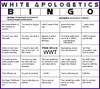
- White apologetics Bingo by arborsalinga
Further reading:
- White Privilege: Unpacking the Invisible Knapsack by Peggy McIntosh
- Shinin' the Lite on White privilege by Sharon Martinas
- Illusions of superiority by Robert Jensen
- Some White People by Renee Martin at Womanist Musings
- The Unapologetic Mexican - The Glosario by Nezua
- With Friends Like These, Who Needs Glenn Beck? Racism and White Privilege on the Liberal Left by Tim Wise
September 16, 2010
no words . . .
You ever seen something so fucked up that you can't even get mad? You ever seen something so beyond the fucking pale that you can't even muster up an emotional response?
This is one of those things.
As Josh would say, "I love the South."
The fucked up thing about this is that if I decided to use this as a fundraiser for Tulpa, or Anne&Me, I'd probably make thousands of dollars.
In the meantime, save the date for November 12! Oh, and check out the open discussion going on at Ars Marginal.
This is one of those things.
As Josh would say, "I love the South."
The fucked up thing about this is that if I decided to use this as a fundraiser for Tulpa, or Anne&Me, I'd probably make thousands of dollars.
In the meantime, save the date for November 12! Oh, and check out the open discussion going on at Ars Marginal.
September 9, 2010
How to do it wrong
I normally enjoy Racialicious, I really do, but this time they dropped the ball. Rather than spell out exactly what's fucked up about it (because it's been said enough times by me and other people), I'll leave it to you, dear reader, to use your native intelligence to discern what is amiss.
Read this (including the comments) and this (including the comments).
And go here if you're still can't put your finger on it.
Read this (including the comments) and this (including the comments).
And go here if you're still can't put your finger on it.
August 26, 2010
Witchsistah is right (h/t Sister Toldja)
Sista Toldja lays out something Witchsistah and I have been saying for years:
This really does make me wonder, though: Why are Black people burdened with this particular expectation? Not just Black people - Black Americans, especially African American women. For real, no other group of people is held to such a standard. Know why? Because it's fucking ridiculous.
If Dr. Laura screamed, "Seig Heil!" eleven times on the air, do you really think people would expect Jews and other groups persecuted during the Holocaust to "just get over it"? Nope! Know why? Because it's fucking ridiculous.
If Mel Gibson yelled, "You're gonna burn in hell with the fags! You're gonna get raped by a bunch of dykes!" do you think people would dare to tell LGBTQ people to "let it go"? Nope. Know why? Because it's fucking ridiculous.
Now women - especially battered women - are at times held to this standard, especially by people who don't know battered women. Trust me, decent human beings who have known women in abusive relationships are a lot less forgiving of abuse. But the thing is - people know how fucking sick it is to ask (demand!) forgiveness for that. People know how sick it is to expect a woman who's been abused to not be fearful or distrustful of men in general because of her experience and the fact that we live in a society that requires men to prove their manhood through their domination of women and turns a blind eye to the inevitable violence that results. Nevertheless, when abuse does come to light, a position of forgiveness and reconciliation is rightly seen as unhealthy, particularly when the abuse is extremely violent.
So why are Black people supposed to tolerate bullshit 'til the cows come home without so much as criticizing - let alone retaliating - the most horrendous shit humanity has to offer? What is it about us that inspires the requirement of saintlike virtue on our part?
Truly, I want to know.
Blatant racism forgiven with the simple words “I’m sorry” brings to mind the phenomenon commonly referred to as Battered Woman’s Syndrome. The victims are unable to walk away from their abuser and continue to return time and time again, without instituting any true demands for an improvement in how they are treated or rehabilitation for their abuser. I have said it once and I will say it again: Black folks will gladly take the moral high road all the way to Hell. Saying “It’s okay” doesn’t always make you the bigger person. ("The Power of No Forgiveness")
If Dr. Laura screamed, "Seig Heil!" eleven times on the air, do you really think people would expect Jews and other groups persecuted during the Holocaust to "just get over it"? Nope! Know why? Because it's fucking ridiculous.
If Mel Gibson yelled, "You're gonna burn in hell with the fags! You're gonna get raped by a bunch of dykes!" do you think people would dare to tell LGBTQ people to "let it go"? Nope. Know why? Because it's fucking ridiculous.
Now women - especially battered women - are at times held to this standard, especially by people who don't know battered women. Trust me, decent human beings who have known women in abusive relationships are a lot less forgiving of abuse. But the thing is - people know how fucking sick it is to ask (demand!) forgiveness for that. People know how sick it is to expect a woman who's been abused to not be fearful or distrustful of men in general because of her experience and the fact that we live in a society that requires men to prove their manhood through their domination of women and turns a blind eye to the inevitable violence that results. Nevertheless, when abuse does come to light, a position of forgiveness and reconciliation is rightly seen as unhealthy, particularly when the abuse is extremely violent.
So why are Black people supposed to tolerate bullshit 'til the cows come home without so much as criticizing - let alone retaliating - the most horrendous shit humanity has to offer? What is it about us that inspires the requirement of saintlike virtue on our part?
Truly, I want to know.
August 19, 2010
Dear Tim (and other White anti-racist activists) . . .
Hey, Tim.
This has been building up for a while, so forgive me if I get emphatic with my statements.
I usually think you're on point about a lot of things, and I've often pointed people in your direction about a breakdown of how racism works in a way that White people can understand (or, shall I say, are willing to listen to). I got a lot of love for you, Tim.
But right now you're fucking up.
What I think a few comments were getting at is the irony of POCs being forced to do for free what White people get paid to do - even though POCs, by virtue of being POCs in a White supremacist society - are more qualified to talk about it. Not to mention, the risks for us are greater than they are for any White person. I've been a queer Black woman in America for 30 years. I attended an HBCU. I'm writing a play right now that dramatizes what this is like for a real live human being. I've been told that I'm extremely intelligent, that I say a lot of things that need to be said in a few words, yet no one is paying me despite what it costs me to do this.
No one is arguing that the work White anti-racist activists are doing is worthless. But what I see is that the work of White anti-racist activists is treated as more valuable than anti-racist activists of color from the get-go. The problem is not that White anti-racist activists like you get paid to do your work. It's that POCs are expected to do the same shit for free. And I can't pretend that it doesn't piss me off. Even guests on Jerry Springer and Maury Povich get better treatment - at least they are financially compensated for destroying their own dignity.
Here I am - with all my intelligence, all my passion, all my creativity, all the people who "value my input" and "learned so much" from me about the same shit White anti-racists are talking about, all this that is so remarkable about me, all this that is worth so much - flat broke, unemployed and genuinely apprehensive about my immediate future. And I'm not the only one like me.
Believe me, that's bad enough. Yet your knee-jerk defensive responses to such critique are so predictable in their irony that I almost want to cry. Seriously, it's almost like you really want to say, "Aren't I doing enough for you people? What more do you people want from me?" You're so busy trotting out your anti-racism cred (really, you're not that far from "I read a book/took a class/asked my Black friends") that you don't see the irony of you making a career out of something POCs are expected to provide as a community service.
Why do I feel like I'm repeating myself? Oh yeah, because I am! What was that brilliant shit I said all them months ago?
Does it make more sense now?
This has been building up for a while, so forgive me if I get emphatic with my statements.
I usually think you're on point about a lot of things, and I've often pointed people in your direction about a breakdown of how racism works in a way that White people can understand (or, shall I say, are willing to listen to). I got a lot of love for you, Tim.
But right now you're fucking up.
What I think a few comments were getting at is the irony of POCs being forced to do for free what White people get paid to do - even though POCs, by virtue of being POCs in a White supremacist society - are more qualified to talk about it. Not to mention, the risks for us are greater than they are for any White person. I've been a queer Black woman in America for 30 years. I attended an HBCU. I'm writing a play right now that dramatizes what this is like for a real live human being. I've been told that I'm extremely intelligent, that I say a lot of things that need to be said in a few words, yet no one is paying me despite what it costs me to do this.
No one is arguing that the work White anti-racist activists are doing is worthless. But what I see is that the work of White anti-racist activists is treated as more valuable than anti-racist activists of color from the get-go. The problem is not that White anti-racist activists like you get paid to do your work. It's that POCs are expected to do the same shit for free. And I can't pretend that it doesn't piss me off. Even guests on Jerry Springer and Maury Povich get better treatment - at least they are financially compensated for destroying their own dignity.
Here I am - with all my intelligence, all my passion, all my creativity, all the people who "value my input" and "learned so much" from me about the same shit White anti-racists are talking about, all this that is so remarkable about me, all this that is worth so much - flat broke, unemployed and genuinely apprehensive about my immediate future. And I'm not the only one like me.
Believe me, that's bad enough. Yet your knee-jerk defensive responses to such critique are so predictable in their irony that I almost want to cry. Seriously, it's almost like you really want to say, "Aren't I doing enough for you people? What more do you people want from me?" You're so busy trotting out your anti-racism cred (really, you're not that far from "I read a book/took a class/asked my Black friends") that you don't see the irony of you making a career out of something POCs are expected to provide as a community service.
Why do I feel like I'm repeating myself? Oh yeah, because I am! What was that brilliant shit I said all them months ago?
What I was thinking is that there's nothing wrong with White anti-racist activists doing their thing. Nothing wrong at all because, as POCs already know, White people listen to other White people (at least when they're in the Completely Clueless phase).
But as I was saying to another blogger, it would be nice if these White luminaries would use their White privilege for good by providing opportunities for other POCs to rise to their level of prosperity.
It's not enough for a White activist to say that they got all their ideas from POCs. That's just being honest about stealing our shit and profiting from it. "I got some of my best stuff from these particular people of color. They are alive right now, and you can talk to them today." Or, better yet, "Everything you hear today has already been said by a person of color. As a matter of fact, they probably already told you what I'm going to tell you today, but you ignored them."
Put the money where the mouth is. Literally. What good is all the talk about anti-racist activism if the people getting most of the book deals, speaking engagements, and accolades are White? What good is all the talk about dismantling White supremacy when the anti-racism industry is dominated by White faces and White voices?
Anti-racism credentials are for shit if most people benefiting materially from it are White.
Does it make more sense now?
August 13, 2010
the n-word train is never late
After saying fucked up homophobic and misogynistic shit, it was only a matter of time before Dr. Laura started saying fucked up shit about Black folks.
What gets me is how people are actually defending this bullshit. Seriously, how is saying "nigger" 11 times in 5 minutes (without being in a Quentin Tarantino movie) not racist? As a matter of fact, since even screaming "nigger" on air or in public doesn't count, when do we get to say something is racist? Does it have to be something like, "I hate Black people because they're Black"? Would it count then?
What a mind fuck.
What gets me is how people are actually defending this bullshit. Seriously, how is saying "nigger" 11 times in 5 minutes (without being in a Quentin Tarantino movie) not racist? As a matter of fact, since even screaming "nigger" on air or in public doesn't count, when do we get to say something is racist? Does it have to be something like, "I hate Black people because they're Black"? Would it count then?
What a mind fuck.
July 23, 2010
"luke . . . i am your father" (h/t postbourgie)
Over at PostBourgie, a comment left by Paula says:
I guess my problem is that it’s very easy to see why Breitbart gets away w/ this shit. He’s playing on the always-persistent, niggling idea that minorities are there to hustle a system that gives them an unearned advantage over whites. Because we’re a nation of either cowards, intellectually immature, or sadly undereducated, we never confront these underlying issues of bias. What I see people in the lefty blogosphere doing now is not so very different from what the NAACP, Vilsack, and Obama have done — which is to separate themselves from the “poison” as fast as possible with as much bluster and self-righteousness as possible. It’s Breitbart’s/NAACP/Obama’s fault!!
It’s never OUR fault, of course. It’s never our responsibility to accept failings that come a result of social conditioning that may take centuries to erase. Just as Vilsack et al must have initially assumed that Sherrod was a “bad” person who had no connection to anything they were doing in the name of equality, we’re now assuming that Breitbart is some toad who is not really a part of us, that his power exists independent of our society’s willingness to support him.In other words - life imitates Star Wars.
July 21, 2010
Fandom really sucks sometimes
I gotta get something off my chest right quick:I participate in fandom. Can't help it. I'm a nerd.
And if you thought corporate America was a cesspool of head-up-the-ass privilege and soul-crushing oppression, you haven't seen the depths to which fandom can go. At least corporate America has the decency to lie about not being sexist, racist, homophobic, transphobic, and full of class elitism. At least you could say that in corporate America, it's all about the Almighty Dollar and the Bottom Line, so you can kind of sweep all the shit they do under that particular Umbrella of Evil.
But fandom - oh, man! Not only are people not making any money off fandom (so have less excuse to put people through that shit), but oftentimes the whole point of the way they indulge in fucked up oppressive dynamics is part of the fun. It's not like gangs where the different oppressions keep to their turf for the most part: racism over here, sexism over there, homophobia and transphobia a few blocks down, ableism by corner. Oh, no! It's not that fucking nice! Those fuckers hang out in clusters. When you see racism, you can bet your ass that sexism (fuck it - let's just say misogyny) is on its way. If you get a glimpse of trans fail, you may as well don your anti-homophobia suit because the anti-queer shit is right around the corner. And despite its "handicap," the ableist train is never late.
And the most fucked-up Jedi mind trick in all this is that no matter how clearly you can see it and point it out and explain it . . .
And if you thought corporate America was a cesspool of head-up-the-ass privilege and soul-crushing oppression, you haven't seen the depths to which fandom can go. At least corporate America has the decency to lie about not being sexist, racist, homophobic, transphobic, and full of class elitism. At least you could say that in corporate America, it's all about the Almighty Dollar and the Bottom Line, so you can kind of sweep all the shit they do under that particular Umbrella of Evil.
But fandom - oh, man! Not only are people not making any money off fandom (so have less excuse to put people through that shit), but oftentimes the whole point of the way they indulge in fucked up oppressive dynamics is part of the fun. It's not like gangs where the different oppressions keep to their turf for the most part: racism over here, sexism over there, homophobia and transphobia a few blocks down, ableism by corner. Oh, no! It's not that fucking nice! Those fuckers hang out in clusters. When you see racism, you can bet your ass that sexism (fuck it - let's just say misogyny) is on its way. If you get a glimpse of trans fail, you may as well don your anti-homophobia suit because the anti-queer shit is right around the corner. And despite its "handicap," the ableist train is never late.
And the most fucked-up Jedi mind trick in all this is that no matter how clearly you can see it and point it out and explain it . . .
- They didn't mean to, so it doesn't count
- You weren't polite about it, so it doesn't count
- There are More Important Things To Talk About, so it doesn't count
- You're obviously paranoid (aka "sensitive"), so it doesn't count
- They never heard it before, so it doesn't count
- You didn't cite your sources, so it doesn't count
And even when it does count, you bring it on yourself by . . .
- Dressing like that
- Talking about that
- Thinking about that so much
Don't you know? It's far more important that you don't harsh the squee than it is for you to feel included like other human beings.
June 15, 2010
June 12, 2010
Top 10 things that won't get said in "Tulpa, or Anne&Me"
I'm going to let you in on a little secret. Sometimes (probably even most times), what you don't say is more important than what you do say. In the spirit of remaining silent and being thought a fool instead of opening your mouth and removing all doubt, I present my own personal Top 10 - a list of Things That Won't Get Said in Tulpa, or Anne&Me (so we can have a real conversation already):
Inspiration: Racism Bingo.
10. "Anti-racist"
9. "White privilege"
8. "The Autobiography of Malcolm X"
7. "Part Cherokee"
6. "Colorblind"
5. "I have Black friends"
4. "Reverse racism"
3. "Why are Black people so angry?"
2. "I'm not racist, but . . . "
1. (White Woman's Tears)
Inspiration: Racism Bingo.

May 28, 2010
If this were your kid . . .
Considering where I went to school, I'm not surprised at all that this shit happened.
But if you want some real amusement, keep track of all the mental gymnastics that are going to happen to pain this as not racist.
Now I'm just waiting for the day when "God Hates Fags/Dykes" posters aren't homophobic and hateful, but ironic. Funny, even.
But if you want some real amusement, keep track of all the mental gymnastics that are going to happen to pain this as not racist.
Now I'm just waiting for the day when "God Hates Fags/Dykes" posters aren't homophobic and hateful, but ironic. Funny, even.
May 20, 2010
What the fucking fuck?
You may have heard about Aiyana Jones. You know, the 7-year-old girl who got shot in the neck by Detroit PD? I wish I could say I'm surprised. But I'm not. This could've just as easily happened here in NYC.
(If you value your blood pressure, don't read the comments. Just. Don't.)
As they say in Star Wars, "I have a bad feeling about this."
I'm pretty sure some French aristocrats said the same thing when they first saw a guillotine.
(If you value your blood pressure, don't read the comments. Just. Don't.)
As they say in Star Wars, "I have a bad feeling about this."
I'm pretty sure some French aristocrats said the same thing when they first saw a guillotine.
Subscribe to:
Posts (Atom)